

Knowledge Management is of crucial importance to efficient construction project management. The growing complexity of project work means that an increasing number of technical and social relationships/interfaces must be taken into account by project managers in adapting knowledge and experiences from earlier projects.
— A. N. Prakash
Introduction
The need to manage projects well and to learn from one project to the next is of vital importance as the whole world becomes more and more project based. Our management of complex projects is often seen as less effective than it might be, and consequently, we need to learn from one project to the next. But in practice, projects are all too often not reviewed at all for various reasons. And even if they are reviewed, reviews often don’t try to explain the complexity in terms of either success or failure and therefore there is no understanding about what went wrong or right. So with few exceptions, project reviews / “lessons learned” are rarely performed and useful lessons captured. Therefore, it is necessary for a project based organisation to set processes through which the knowledge/experience is regularly captured and shared within the organisation to make it a very efficient functionally learned organisation.
What Is Knowledge Management (KM)
Unfortunately, there is no universal definition of Knowledge Management (KM), as there is no agreement as to what constitutes Knowledge in the first place. For this reason, it is best to think of Knowledge Management in broad terms.
Very simply put, Knowledge Management is the process through which organisations generate value from their intellectual and knowledge based assets. Most often generating values from such assets involves codifying what employees and customers know, and sharing that information within the organisation and even with other companies in an effort to devise best practices.
It is important to note that the definition says nothing about the technology; while Knowledge Management is often facilitated by IT, technology by itself is not KM.
Projects are, by nature, temporary endeavours, and any learning that is accumulated in construction project will largely dissipate at the end of the project unless attention is paid to the collection and dissemination of that knowledge.
“Knowledge is the capability for effective action. Information, skills and experience an individual uses in a process to interpret information, in order to make decisions. Knowledge is in the mind of individual” as defined by Peter Drucker. The concept of knowledge has to be distinguished from “data” and “information”. Data is unorganised raw facts and figures. Information is processed data. “Information” is data in a purposeful and meaningful context. The process begins with “data” being organised to produce “general information”. The next stage moves this “general information” being sorted out and structured to produce information that meets the requirements of a specific group of users. Individuals then absorb this information and transform it into knowledge on the basis of individuals’ experiences, attitudes and the context in which they work.
Unless knowledge leads to an informed decision, the whole process is useless. Knowledge can be categorised into (1) Tacit knowledge and (2) Explicit knowledge.

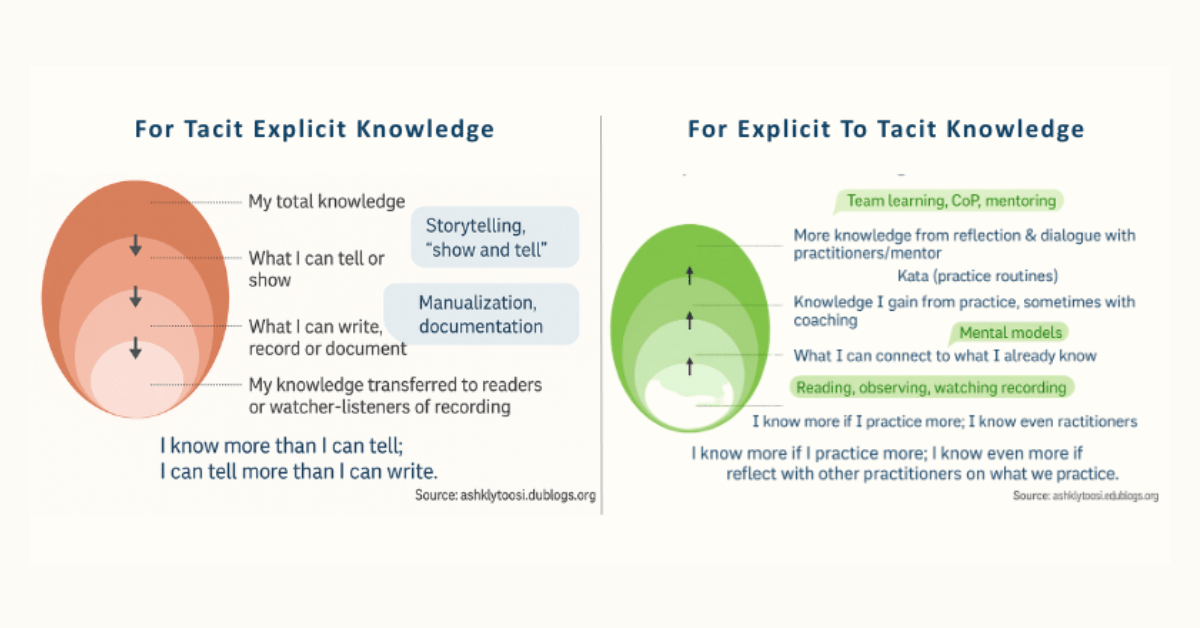
“Tacit” knowledge resides in the emotions and behaviour of human beings. It evolves from people’s interactions and requires skill and practice whereas “Explicit” knowledge is documented, public, structured, externalised and conscious. It has a fixed content that can be captured and shared through information technology.
Explicit knowledge are assets such as patents, trade marks, business plans, marketing research etc. As a general rule of thumb, explicit knowledge consists of anything that can be documented, archived and codified, often with the help of IT.
Project Based Organisations and Project Management
Project management was previously regarded as a specialised management process with a specific planning, monitoring and control techniques that was applied to the operations of a few construction projects. It has now come to be regarded as an inclusive concept that can be integrated into a general organizational effort to provide better quality to customers through effective intra organizational integration and optimal utilization of scarce resources.
Project Management and Knowledge Transfer
Knowledge Management is of crucial importance to efficient construction project management. The growing complexity of project work means that an increasing number of technical and social relationships/interfaces must be taken into account by project managers when planning knowledge and experiences from previous projects. Project team members need to learn things that are already applied in similar projects in their environment, and to assimilate knowledge that is not dependent on the individual members themselves but is in the domain of the organization. The failure to transfer knowledge between projects is one of the major obstacles to the overall effectiveness, efficiency and profitability of an organisation.
Table 1 – The Main Reasons for Not Putting Effort into the Lessons Learned Process.
| REASON | RESPONSES % |
|---|---|
| Lack of employee time | 67.0% |
| Lack of management support | 52.5% |
| Lack of incentive | 53.7% |
| Lack of resources | 53.1% |
| Lack of clear guidelines | 32.2% |
| Lack of support from other organisations | 32.2% |
| Our process does not capture useful lessons | 20.9% |
| Data repository too hard to search | 20.9% |
| Lessons are not transferable | 13.3% |
| Wrong people are involved | 8.4% |
| We already put in enough effort | 8.4% |
Obstacles and Hurdles to Knowledge Transfer
In a project based organisation, there are several obstacles and hurdles which obstruct easy transfer of knowledge from one project to another within the organization. Reasons for this could be many such as:
-
Team members from one completed project will have to take over another project some times even within a very short time.
-
Paucity of time and pressure of work makes it precarious; we necessarily live in result of a completed project and document the knowledge and experiences derived from it. Effective capturing project schedule data and time management practices can help alleviate these pressures.
-
Hesitation towards honest and open analysis of failures and mistakes.
-
Socio-economic background that prevents clear communication and documentation.
-
Motivation to undertake a proper review of the problem etc.
-
Lack of leadership within the organisation to promote knowledge sharing.
How to Overcome Obstacles and Hurdles
A project based organisation should put in efforts to make this knowledge sharing / Knowledge Management as a part of its culture. An organisation ensures its own functions for its management systems and provides norms regarding the “right” and “wrong” ways of operation. Organisation culture stabilises the firms’ method of operation. The over all project plan for execution of the project should include “lessons learnt” as a part of the project execution plan to be documented at the end of the project.
Effective ways of sorting useful from useless information would ensure flow of information. Organisation should ensure social interaction within the project team to another project team to ensure knowledge transfer. Implementing team-based knowledge sharing practices can significantly enhance collaboration between project teams.
If cannot on its own ensure knowledge transfer without the help of communication among people. Therefore, within the team and within the organisation, within the team leadership becomes very essential.
Benefits of Knowledge Management
-
A lot of theoretical work has been done by various people in the field over the necessity of Knowledge Management.
-
There are a number of reasons why Knowledge Management should become part of the organisation’s culture.
-
Project managers learn how to manage experimentally and it’s important to reflect and learn these lessons.
-
Lessons learnt from one project can help in risk analysis during the initial planning of the next project.
-
Lessons learnt from projects could be utilised to improve project management processes.
-
It could be used to improve in decision making.
-
Lessons learnt procedures are important to disseminate knowledge within the project team.
-
Lessons learnt are useful for bench marking.
-
This could also help in assessing the performance of personnel.
Conclusion
It is very crucial for project based organisation to inculcate a culture to accept, adopt and utilise knowledge transfer activities.
It is undoubtedly evident that large project based organisations knowledge sharing within the organisation through various processes is of utmost importance to be able to survive in the age of innovation and competition. Modern approaches such as integrating BIM for data flow can further enhance knowledge management capabilities in construction projects.
References:
-
Mian M Ajmal and Kaj U Koskinen; Knowledge Transfer in Project Based Organisations: An Organisational Culture Perspective, Project Management Journal – March 2008.
-
Post project reviews to gain effective lessons learned – Terry Williams, PhD. PMP a PMI publication.
-
Patricia M. Carrillo, Chimay J. Anumba, John M. Kamara – Department of Civil and Building Engineering, Loughborough University. Knowledge Management strategy for construction: Key I.T. and contextual issues.