

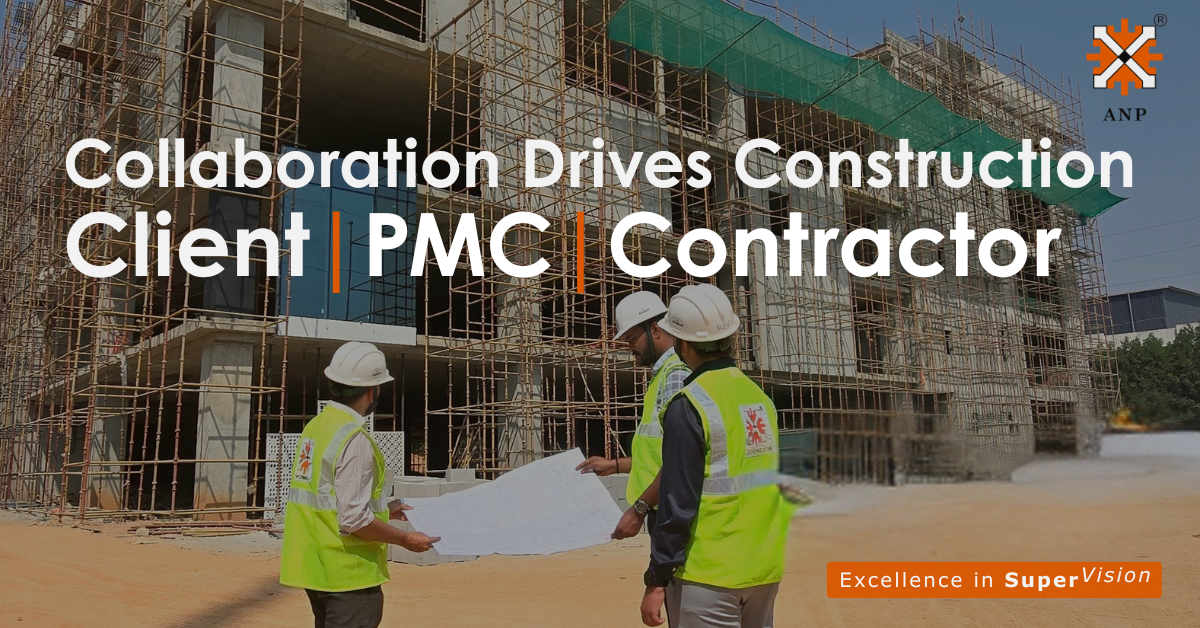
Construction is one of the most dynamic and challenging industries in India. Every project—be it a township, hospital, IT park, metro station, or a five-star hotel—requires seamless coordination among multiple stakeholders. Among them, three players stand out as the pillars of successful delivery: the Client (the owner or developer), the Contractor (the executor of works), and the Project Management Consultant (PMC).
In theory, each of these stakeholders has a clear role to play. The client provides vision and investment, the contractor brings technical execution and manpower, and the PMC acts as the integrator, ensuring alignment of quality, cost, safety, and timelines. But in practice, collaboration among these three is not always smooth. Misunderstandings, misaligned expectations, poor communication, and contract disputes often derail projects, leading to time and cost overruns—a recurring issue in the Indian construction industry.
This blog explores in detail how effective collaboration between clients, contractors, and PMCs can transform project delivery. It presents practical insights, case-based examples from Indian projects, and actionable strategies for fostering trust and coordination. To understand more about the role of PMCs, read our complete guide to construction project management consultancy.
The Indian Construction Landscape
Growth and Complexity of Projects
India's construction sector is expected to reach USD 1.4 trillion by 2030, driven by government initiatives like Smart Cities Mission, Gati Shakti, and Housing for All. Projects today are larger, more complex, and demand specialised expertise.
- Mega projects like airports, IT campuses, metro corridors, and industrial parks require multiple contractors and sub-contractors.
- Tight schedules are imposed by market conditions, financing structures, and competition.
- Stringent quality and safety norms are being adopted as clients aim for global standards.
In this backdrop, collaboration among stakeholders becomes not just beneficial but essential.
Challenges in the Absence of Collaboration
When collaboration is missing, projects face:
- Cost escalations due to poor coordination.
- Delays arising from disputes between contractors and clients.
- Rework caused by unclear instructions or lack of monitoring.
- Loss of trust and strained relationships, leading to litigation.
The industry has many examples where adversarial relationships have turned potentially landmark projects into long-drawn disputes.
Roles of the Key Stakeholders

The Client
The client is the owner or developer—the one who provides the vision and financial backing. Their responsibilities include:
- Defining project objectives (scope, quality, budget, and schedule).
- Selecting the right contractor and PMC.
- Ensuring timely payments and approvals.
- Providing clarity in decision-making.
The client's role is like that of a captain, setting direction and ensuring the ship sails smoothly.
The Contractor
The contractor is the executor on the ground. Their responsibilities include:
- Deploying manpower, materials, equipment, and methods.
- Delivering works as per drawings, specifications, and safety norms.
- Coordinating with sub-contractors.
- Raising bills, variations, and claims transparently.
The contractor's performance is most visible, as the actual structure stands on their work.
The PMC (Project Management Consultant)
The PMC acts as the bridge between the client and contractor. Their responsibilities are:
- Project planning, scheduling, and monitoring.
- Quality assurance and safety checks.
- Cost control and contract administration.
- Acting as a communication channel, ensuring issues are resolved early.
A good PMC is like a conductor of an orchestra—ensuring each instrument plays in tune, creating harmony. Learn more about building strong teams in CPMC.
Why Collaboration Matters
The Triangular Relationship
Think of the Client, Contractor, and PMC as three corners of a triangle. If any side weakens, the entire structure collapses. Collaboration strengthens this triangle by:
- Aligning expectations from the beginning.
- Avoiding duplication of work or gaps in responsibility.
- Encouraging transparency in progress, payments, and risks.
- Creating a problem-solving culture rather than a blame game.
Indian Case Example: In a metro rail project in South India, delays occurred because the contractor was not given timely design approvals from the client. The PMC identified this bottleneck and created a joint decision-making protocol, where weekly meetings ensured drawings were approved within 7 days. This collaborative step reduced delays by 30% and saved significant costs.
Collaboration in Each Project Phase
Pre-Construction Phase
This phase sets the tone for the entire project. Collaboration is critical in:
- Defining scope clearly – Clients, contractors, and PMCs must agree on specifications.
- Finalising realistic schedules – Contractors give inputs on execution feasibility. Learn more about effective time management in construction projects.
- Risk assessment – PMC identifies potential delays or cost escalations, enabling mitigation plans.
Tools: Kick-off meetings, pre-bid conferences, joint risk workshops. Effective inter-disciplinary coordination is essential at this stage.
Construction Phase
Here, day-to-day coordination decides whether the project succeeds or falters. Key collaborative practices:
- Daily/weekly progress meetings among client, contractor, and PMC.
- Transparent billing process – PMC verifies contractor bills, client releases payments promptly.
- Joint site walks – to resolve issues immediately.
- Dispute resolution mechanisms – small conflicts resolved on site rather than escalating.
Post-Construction and Handover
At this stage, collaboration ensures smooth closure:
- Joint inspections for snag lists.
- Clear documentation of warranties, as-built drawings, and O&M manuals.
- Feedback loop – all three stakeholders review lessons learnt for future projects.
Best Practices for Effective Collaboration
Clear Communication Channels
Establish structured reporting systems (daily logs, weekly reports). Use digital tools like BIM, project management software, and dashboards. Encourage face-to-face discussions for critical issues. Discover the importance of balancing technical and soft skills for effective communication.
Role Clarity and Respect
Avoid overlap or interference in responsibilities. The client respects contractor's expertise; the contractor respects PMC's monitoring role.
Transparent Contract and Payments
Clearly drafted contracts with dispute resolution mechanisms. Prompt payment cycles to contractors to maintain trust.
Joint Problem-Solving Culture
Replace adversarial attitudes with collaborative problem-solving. Use structured approaches like root cause analysis, value engineering workshops.
Training and Capacity Building
Joint workshops for client teams, contractors, and PMC staff on quality, safety, and digital tools. Building a culture of collaboration from the top management downwards.
Common Pitfalls and How to Avoid Them
- Unrealistic Deadlines – Avoid by involving contractors in scheduling.
- Ambiguous Scope – Prevent through detailed design and PMC validation.
- Delayed Payments – Establish transparent processes and escrow mechanisms.
- Blame Game – Replace with root cause analysis.
- Ignoring PMC Advice – Clients must respect PMC's technical inputs for timely decisions.
Case Studies from Indian Projects
Case 1: IT Campus in Bangalore
Client wanted a fast-track project. Contractor suggested pre-cast technology, but the client hesitated. The PMC organised workshops with all parties, presenting cost-benefit analysis. The client agreed, and the project finished 4 months ahead of schedule.
Case 2: Affordable Housing in Maharashtra
Contractor faced delays due to local material shortages. PMC facilitated alternate supplier tie-ups and client approved advance payments. Collaboration reduced risk of stoppage.
Case 3: Luxury Hotel in Hyderabad
Disputes arose on finishes between contractor and client. PMC developed a mock-up room for approvals. This collaborative step ensured clarity, saving both time and rework costs.
Technology as an Enabler of Collaboration
- BIM (Building Information Modelling): Provides a single source of truth for all stakeholders. Read more about the role of BIM in construction project management.
- Digital dashboards: Real-time monitoring of cost, schedule, and quality.
- Mobile apps: Instant communication and issue resolution.
- Drones: For progress monitoring and client transparency.
In India, adoption of digital tools is rising, but the true impact comes when all three stakeholders embrace them together. Additionally, proper safety protocols must be integrated into all collaborative efforts.
The Human Element in Collaboration
While tools and contracts help, the success of collaboration ultimately depends on people.
- Trust: Built through consistent transparency.
- Respect: Valuing each stakeholder's role.
- Mindset: Moving from "my work" to "our project".
Indian culture values relationships. When stakeholders treat each other as partners rather than opponents, projects thrive. Effective knowledge management also plays a crucial role in sharing learnings and building institutional memory across projects.
Conclusion
Collaboration between clients, contractors, and PMCs is the backbone of successful construction project management in India. It ensures projects are delivered on time, within budget, and with the desired quality.
When these three work together in harmony, challenges become opportunities, disputes turn into innovations, and projects become landmarks.
At AN Prakash Construction Project Management Consultants (ANPCPMC), we have seen first-hand how collaboration transforms projects—be it mega IT campuses, affordable housing, or luxury hotels. Our experience shows that collaboration is not just a practice but a culture that drives success.
Ready to Experience the Power of Collaboration?
If you are planning a project and want to experience the power of structured collaboration, connect with ANPCPMC. Our expertise ensures that your project vision is realised with efficiency, quality, and trust.