
Abstract: Construction Project Management (CPM) plays a significant role in all construction projects, particularly in services-intensive projects such as hospitals, hotels, and R&D laboratories, where mechanical, electrical, plumbing, and firefighting systems are extensively involved. The importance of Construction Project Management in interdisciplinary coordination becomes especially evident in such complex settings, where seamless integration between multiple disciplines is critical for project success. The implementation of CPM processes, supported by modern tools like Building Information Modelling (BIM) and Virtual Design and Construction (VDC), helps address these challenges effectively. Strong project management skills in a project manager are essential to navigate and coordinate such technically demanding projects.
A study facilitated by the Ministry of Statistics and Programme Implementation (MoSPI), conducted by KPMG and the Project Management Institute (PMI), analysed the reasons for time and cost overruns in central sector infrastructure projects. The projects surveyed in the report span nine key infrastructure sectors: Power, Petroleum, Coal, Steel, Railways, Roads and Highways, Civil Aviation, Ports and Shipping, and Telecom.
Following are excerpts from the report:
Table 1: Reasons for project time overruns across the project lifecycle
| Stages | External issues | Internal issues |
| Pre-planning |
|
|
| Planning and design |
|
|
| Execution and monitoring |
|
|
| Closure and
handover |
|
|
Source: PMI-KPMG, Study on project schedule and cost overruns
In the same report, main reason attributed to projects not meeting their deliverables and for project time and cost overruns is shortage of “Skilled Project Managers”. Added to that is prolonged procedures due to bureaucracy and out dated methods of selection of contractors and vendors resulting in delays in finalisation of designs, scope creep, construction disputes.
The report further adds that about 72 percent of the respondents consider internal training programmes such as developing in-house Project Academy / Centre for Management Excellence for training and certifying Project Managers as the pertinent step to enhance the quality of talent available.
Construction Project and its Life Cycle
A Construction Project in its life cycle goes through the following phases viz.
- Concept phase
- Planning phase (Design development and Tendering)
- Execution phase
- Close-out phase.
In each and every phase of a Construction Project life cycle, Construction Project Management plays an important role.
What is Construction Project Management?
Construction Project management is the application of knowledge, skills, tools and techniques to project activities to meet the project requirements.
Planning and scheduling is an important part of Construction Project management. The term construction does not denote construction activities involving men, machinery and materials, but also, covers the entire gamut of activities frm conception to completion of a construction management.
All the activities and processes that take place in a construction project may be grouped as follows:
- Initiating process
- Planning Process
- Executing process
- Monitoring and Controlling process
- Closing Process
The role of Construction project becomes all the more important and demanding particularly in services (namely Electrical, Plumbing, Firefighting, HVAC, communication etc.,) intensive buildings.
In services intensive buildings such as Hospitals, Hotels, Laboratories, R & D facilities, IT buildings there are very many agencies / stake holders involved as compared to a conventional buildings such as Residential apartments or a Commercial building.
Project management and its processes became more relevant and important particularly in the case of services intensive projects and consequently the function of a Project Manager.
Coordination of mechanical, electrical, plumbing, and firefighting systems from the design phase to the tendering phase and through the construction phase provides a major challenge for services intensive buildings and industrial projects.
The distributed knowledge of different specialists, such as the Architects, Structural Engineers, MEP design engineers, and the coordination of their individual requirements in a project poses a major challenge at the design and the tendering phase.
During the construction phase, the challenge gets more complicated and further as the number of agencies increases and the coordination of work gets complicated, the blame game begins.
Challenges that are faced in coordinating a multi-disciplinary project
The following Table-2 shows the number of agencies that are involved in three different Hospital projects under each category.
Table 2: Work Packages in Hospital Construction
| # | Category | Hospital 1 | Hospital 2 | Hospital 3 |
| 1 | Civil | 6 | 8 | 8 |
| 2 | Electrical | 13 | 15 | 13 |
| 3 | PHE | 6 | 8 | 5 |
| 4 | Firefighting | 3 | 3 | 3 |
| 5 | HVAC | 2 | 3 | 1 |
| 6 | Mechanical | 2 | 1 | 2 |
| 7 | BMS (Building Management System) | 5 | 4 | 5 |
| 8 | Vertical Transport (Lifts, Escalators) | 2 | 2 | 2 |
| 9 | Furnishing | 3 | 2 | 3 |
| 10 | Loose Furniture | 5 | 4 | 5 |
| 11 | Medical Gas System | 1 | 1 | 1 |
| 12 | Hospital System | 4 | 6 | 3 |
| 13 | Interior | 10 | 10 | 4 |
| 14 | IT | 3 | 4 | 3 |
| 15 | Medical equipment | 10 | 12 | 8 |
| 16 | Medical Water supply | 1 | 1 | 1 |
| 17 | External Development | 2 | 2 | 2 |
| 18 | Safety | – | – | 1 |
| TOTAL | 78 | 86 | 70 |
It is very obvious by looking at the above table and the number agencies involved, in the absence of standard operating procedures (SOPs) and construction management process in place, the project is bound to have not only time and cost overruns but also quality issues.
Let us look at the challenges that are met at every stage of a multi-disciplinary project:
Design phase:
The MEP system in technically challenging projects like those focussed on the high technology, health care, hospitality, bio-tech industries can compromise as much as 50 percent of the project value. The MEP system need to be routed in limited space under the design, construction and maintenance criteria established for the systems.
The following Table-3 is prepared to demonstrate how each of the designers are dependent on input data from each other to be able to incorporate all the , the client, the user and many other stake holders to be able to complete their respective designs in a comprehensive manner.
The design co-ordination meetings spear headed by a Project Manager who acts as a Project coordinator is very important and relevant at this stage of the project. The challenges gets more complicated if the designers are not from one firm and are from different consulting firms.
The role of the Project Coordinator would be:
- To ensure that proper and timely communication takes place between all the designers and they do not miss out on very important data or information as a result of which major changes have to be made during execution of performance of the facility compromised.
- To ensure that the drawings are mutually well coordinated to avoid overlap of different services.
- Preparation of a services co-ordinated drawing. The responsibility of preparing an ‘all services co-ordinated drawing’ to be issued for construction.
Table 3: Dependency between designers
| # | Who is Designing? | What is the requirement? | Who has to give inputs to the designer? |
| 1. | Structural | Opening in slabs and beams | HVAC, Firefighting |
| 2. | Structural | Foundations for equipment and machinery | HVAC, Electrical, Plumbing and Firefighting |
| 3. | Structural (Industrial) | Suspended suction pipe/ ducts, false ceiling | Services consultant / Equipment vendor |
| 4. | Architect | Scope definition by client | Client |
| 5. | Architect | User requirement of space, power, types of finishes etc. | Client / user |
| 6. | Architect | Size of shafts for services | Plumbing, Electrical, HVAC designers |
| 7. | Plumbing consultants | Processed water requirement | User |
| 8. | Plumbing consultants | Quality of processed water | User |
| 9. | Plumbing consultants | Quantity of water required | HVAC, Firefighting etc. |
| 10. | Electrical | Process power requirements | User |
| 11. | Electrical | Power requirement for pumps, chillers, equipment. | Plumbing, HVAC, Lift user |
Tendering phase:
Lack of coordination between different agencies and their requirements while preparing the tender documents could result in plenty of Non-tendered items. This in turn would lead to extended time and cost overruns.
Table 4 shows the dependencies of various ‘item of work’ ‘Required by’ a particular agency ‘to be executed’ by another agency and the ‘impact’ on the project if the item of work is not included in the tender as an item of work.
For example: The (Quantity surveyor) QS, while preparing civil works tender he/she has to ensure that all the items of work on which the other agencies such as Plumbing and firefighting/HVAC/Electrical depend on, are included.
- Foundation for pumps, Generators, transformer and any other equipment.
- Openings in wall for passing ducts.
- Power for testing and commissioning
- Water for testing Fire-fighting system.
- Fencing for Substation.
Not providing for these could result in ‘non-tendered items of work which will have impact not only on cost will also have on time.
The project co-ordinator plays an important role in collating all the requirements of various design consultants and making sure all of them have been included in the tender documents.
Table 4: Clarity in the specification for each item of work
| # | Item of work | Required by agency | To be executed by | To be included in | impacts |
| 1 | Equipment foundation details | Plumbing and
HVAC |
Civil | Civil | Cost and time |
| 2 | Water for testing and commissioning | Firefighting | Plumbing agency / Civil / Client | Civil works | Execution co-ordination |
| 3 | Power for testing and commissioning | lifts | Electrical | Electrical | time, cost and co-ordination |
| 4 | Scaffolding in lift shafts | Lift | Civil | Civil | |
| 5 | Opening in walls to lay ducts / pipes | HVAC | Civil | ||
| 6 | Conduit chasing cover | Electrical | Civil |
Execution Phase:
The challenges that the execution teams face are:
- Lack of ability to identify conflicts due to the 2D representation of the designs
- Delays in the construction process due to conflicts being identified in the field
- Lack of trust in the fabrication offsite due to the fear of the system not fitting leading to a lot of on-the-site fabrication
- Rework to fix the conflict issues not identified during design and coordination
- Increased site supervision required to avoid conflicts between trade contractors
- Increased administrative burden of more Request for Information (RFIs) and Change Orders due to identification of conflicts in the field after budgets are approved
- “Install first” mentality amongst trade contractors so as to avoid having to move their systems in case conflicts arise leading
- Overall reduced productivity for everyone involved in the process.
Planning/scheduling:
Often, the first construction agency working in the area optimises the routing of his systems, resulting requiring expensive rework by other agencies who come in later.
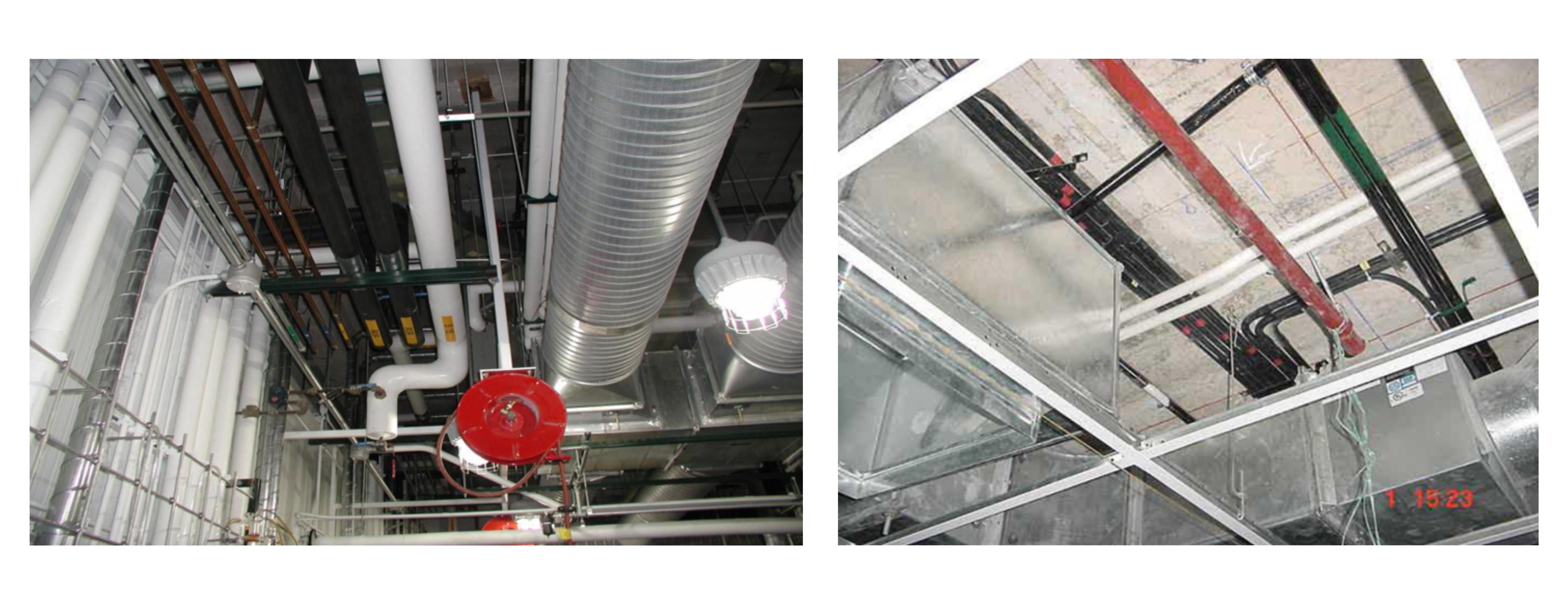
Photo-1 Services on ceiling
Consider preparing a construction schedule for putting up a Testing Laboratory for a R&D facility.
The Testing laboratory would be made of very many engineering services that run above the false ceiling and also on the floor to cater to the requirements of the laboratory.
Services that run above false ceiling would typically consist of:
- HVAC (Heating, ventilation and Air-conditioning) ducts.
- Electrical cables and wires.
- Communication cables.
- Fire detectors.
- Sprinkler pipes.
At the floor level and below a false floor:
- Fresh Water lines.
- Wastewater lines.
- Gas lines.
- Data cables
- Power cables etc.,
Needless to say in the absence of a well-co-ordinated drawing showing the locations of each of the services above false ceiling and their routes, the construction site would be chaotic and in disarray.
We found that while planning execution of this work, it is prudent to segregate the work into two areas namely the above false ceiling work and below false ceiling work. This has helped us in sequencing the work of various agencies. The above false ceiling works are always completed in a sequential manner and then the work at the floor level is taken.
It also helps to make mock-ups of services shafts to understand the constructability and space constraints, particularly in the case of Hotels and Hospitals.

Photo-2 Services shaft in a hotel project

Photo-3 Services shaft as seen from the top
MEP coordination tools:
The use of computer tools such as Building Information Modelling (BIM) (Photo-4) and Virtual Design Construction (VDC) is of great help for both Designers and Project Managers during the execution phase.
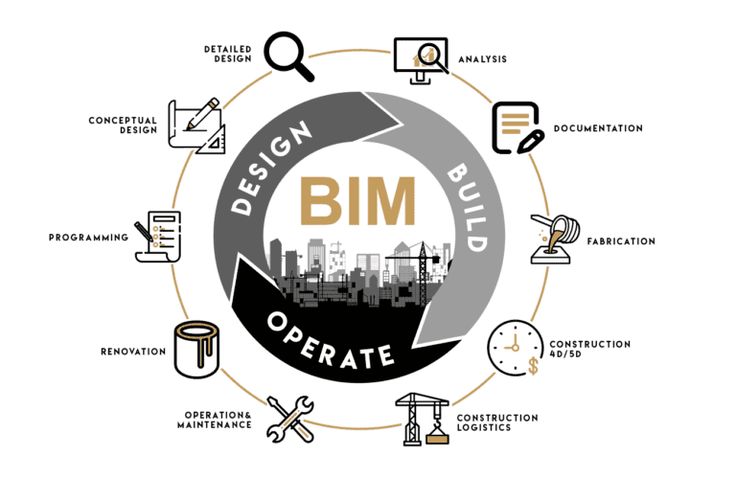
Photo-4 Building Information Modelling (BIM)
With the application of these tools at all the phases of the project. From designing phase to the execution phase the uncertainties that existed in their absence, is greatly reduced. These tools facilitates the designer to visualize every pipe and cable that is to be installed can be seen in a 3D or 4D format. The same tool cane be utilised for arriving at the quantities of various items of work. As indicated in figure, BIM is helpful at every stage of a construction project.
CONCLUSION:
The importance of availability of project management capabilities and skills across the organization to get better returns on the investment made cannot be ignored. Project management with a view to deliver on time and overrun cost is a learnable capability that can be institutionalised.
Therefore in order to be able to complete a services intensive project suggested points of action are:
- Awareness towards importance towards implementation construction project management.
- Impart training in Project Management and its process.
- Ensure Services coordinated drawings are prepared.
- Coordination between different agencies/vendors/consultants to ascertain their requirements.
- Mock up to be prepared at site to help understand the sequence of working etc.
- To avoid scope creep client to give as many details as possible.
- Prepare realistic schedules.
- Prior to execution of work in shafts, it is prudent to prepare a mock up shaft with all the services that are planned to be incorporated.
- Involve the operations team for their in-puts while designing the system.